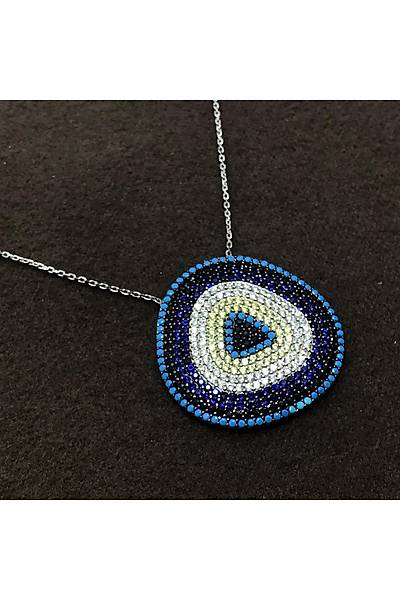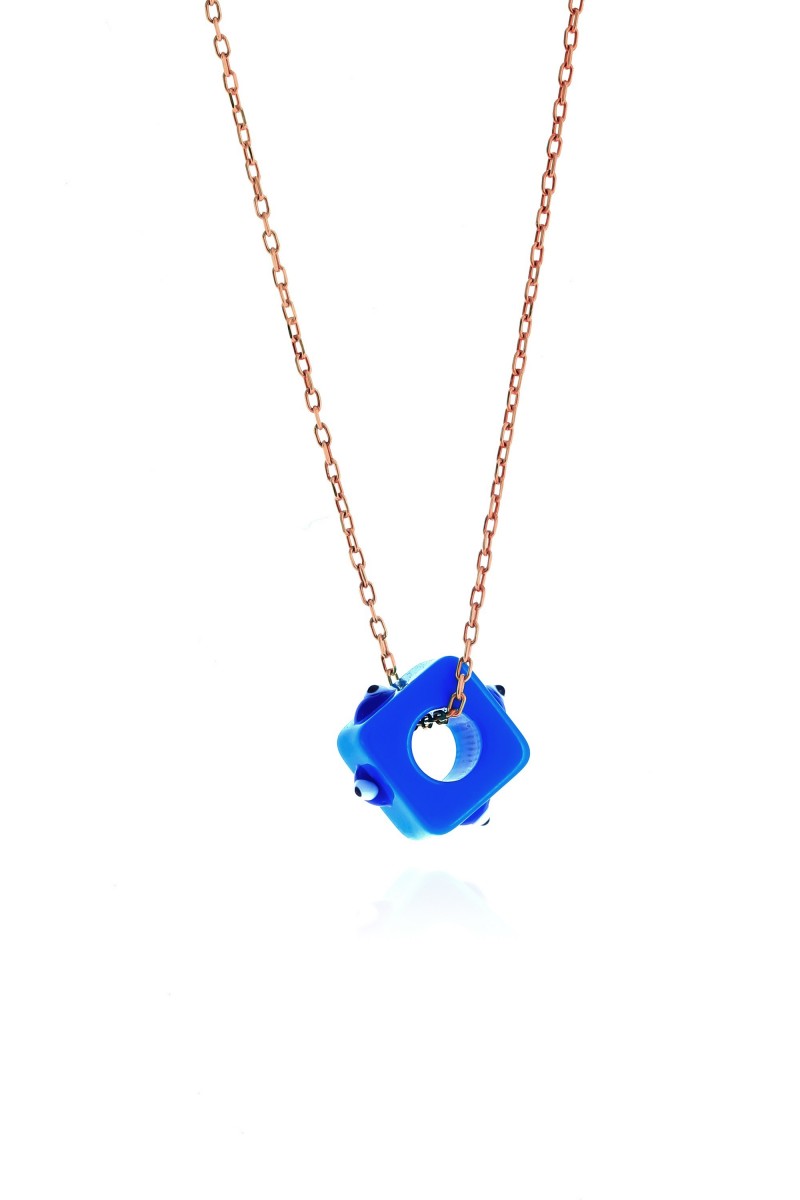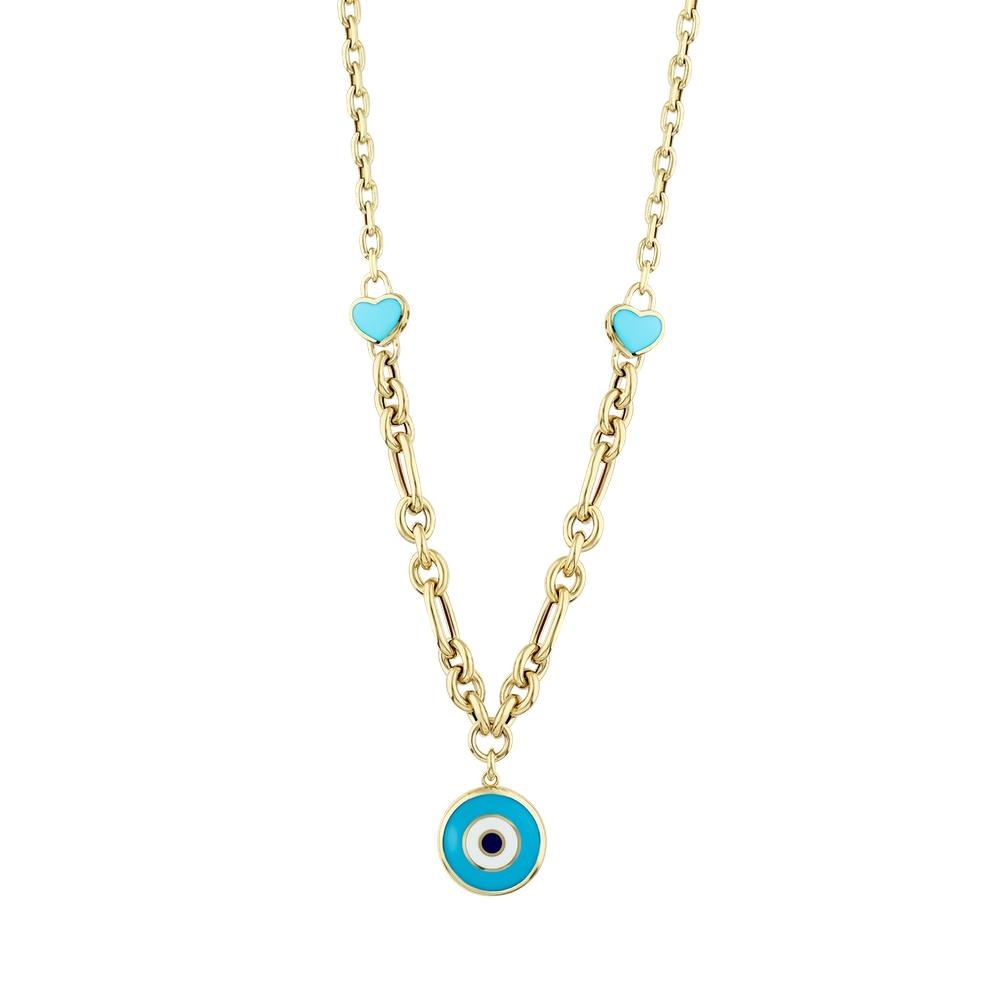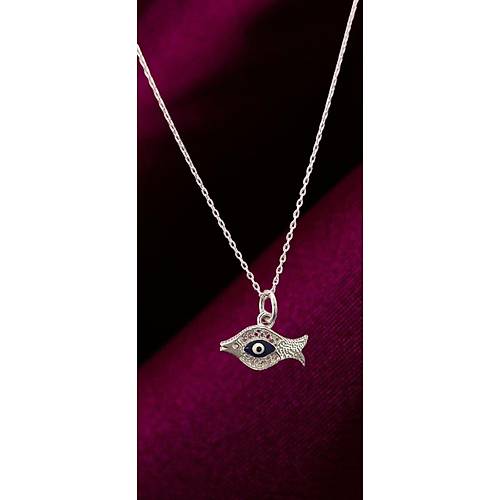
Six hundred and eighty-seven listings in our catalogue have evil eye or nazar in the title. That is out of about thirty thousand, across 78 jewellers, and no other single motif we track comes close. Break those 687 down by category and more than half are necklaces, with bracelets a distant second. Whatever else a Turkish workshop makes, it also makes the eye.
Which is exactly why most of what gets written about it in English is useless. So here is the version with the specifics left in.
The belief is older than any of the religions attached to it
Nazar is Arabic-origin, meaning look or glance. In Turkish, nazar değdi — "the gaze touched it" — is what you say when something good goes wrong for no reason. The child who was thriving and then fell ill. The new car dented in the first week. The idea is not that someone cursed you deliberately. It is that admiration itself, especially uncontrolled admiration, carries a force that damages what it lands on.
That belief is attested across Mesopotamia, Greece and Rome long before Islam, and it survives now in Greece, the Levant, Iran, North Africa, Italy and Latin America in forms a Turkish grandmother would recognise instantly. It is a Mediterranean and Near Eastern idea, not a Turkish or an Islamic one, and it crossed into Islam rather than originating there.
Islam does acknowledge the eye — the 'ayn is treated as real in the hadith literature, and the standard religious response is verbal: the Qur'anic chapters al-Falaq and an-Nas, the phrase mashallah said aloud when you praise something. On whether a bead or an amulet is a legitimate response, scholars have disagreed for centuries and still do. A fair number of observant people in Turkey wear one anyway, and a fair number consider it superstition that a Muslim should drop. We are not going to settle that here, and anyone who tells you the nazar boncuğu is straightforwardly Islamic is skipping an argument that is genuinely open.
What is not in doubt is how deep it goes in daily Anatolian life. Beads on a newborn's shoulder. On the mirror of a truck. Nailed above a shop door on opening day. Pressed into wet concrete on a new house. It functions less as jewellery than as a habit.
Why blue
Three explanations circulate, and only one of them is safe to state as fact.
The demographic one: light eyes are uncommon in most of Anatolia, so the blue-eyed stranger was the face you noticed, and the noticing ran both ways. Plausible, unprovable, and repeated everywhere.
The material one is stronger. Cobalt produces a deep, stable blue in glass at low cost and was available across the eastern Mediterranean for a very long time. Blue glass was simply the colour early glassmakers could make brilliantly and reliably. Some of the colour choice is probably just chemistry.
The third is that blue carried protective associations in Egyptian and Mesopotamian material culture, which it did — but tracing a straight line from a faience amulet to a Turkish bead is more than the evidence supports.
The honest position: nobody can prove why it is blue, several partial explanations overlap, and the shape matters more than the colour anyway. It is an eye looking back. Concentric rings, dark pupil in pale white in blue. The logic is mirror logic — the gaze that damages gets reflected before it arrives.
The furnaces outside İzmir
The part worth knowing is that this is still a hot-glass craft, and it survives in a very small number of places.
The best known is Görece, a village in the Menderes district south of İzmir, along with a handful of nearby workshops. The furnaces there burn wood, and the reason the workshops give for it is not romance: the particular heat of a wood fire, and the way it can be brought up and let down, suits the working temperature of their glass. Whether that is metallurgy or tradition depends on who you ask, and the men working the ovens do not much distinguish between the two.
The method is not moulded. A master gathers molten glass on an iron rod, shapes the blue body, then lays on the pale ring and the dark pupil as separate drops of coloured glass, one on top of the other, working in seconds while everything is still liquid. The layers fuse. Then it is separated from the rod and left to cool slowly, which is the step that decides whether it survives at all — cooled too fast, the glass carries internal stress and cracks weeks later on a shelf.
Two things follow. First, real hand-blown beads are never identical; pupils sit slightly off-centre, rings are not perfect circles, and the back is flatter than the front where it rested. Second, most beads sold as Turkish evil eyes worldwide are pressed or moulded glass, or acrylic, and are flawlessly symmetrical for exactly that reason. Acrylic gives itself away by weight and by warmth — glass is cold to the lip and stays cold for a second.
Work in silver mostly uses small glass or enamel eyes set as cabochons, or the eye rendered in enamel and metal with no glass at all. Both are legitimate. The enamel version will be more durable on a ring, which takes impacts a glass bead will not survive.
The hand, and the other motifs it travels with
The eye rarely travels alone. The most common companion in Turkish work is the Fatma Ana Eli — the Hand of Mother Fatima, known more widely as the hamsa or Hand of Fatima, named for the Prophet's daughter. It is an open palm, usually symmetrical rather than anatomical, and it often has an eye set in the centre of it, which doubles the device rather than duplicating it: the palm is a refusal, the eye is a mirror. Counting titles in our catalogue, pieces naming Fatma or a hamsa run to a few dozen, so it is a real but much smaller category than the eye by itself.
You will also find the eye paired with Qur'anic text — al-Falaq, an-Nas, Ayat al-Kursi — on the same pendant. Roughly forty of our evil eye listings mention a prayer or verse in the title. That pairing is exactly the hybrid the theological argument above is about, and it is popular regardless.
When it breaks
Ask anyone in Turkey what it means when a nazar boncuğu cracks and you will get the same answer without hesitation: it did its job. It took the hit that was meant for you. You thank it, you do not glue it, you do not keep it. You get another one.
Whether or not you hold the belief, it is a good piece of design thinking. The object is consumable by intention. It is not an heirloom, it is a fuse — which is also why the traditional ones are cheap, why they are given rather than bought for oneself, and why a Turkish household has several at once rather than one precious one.
That is worth holding onto if you are buying silver with a set glass eye and treating it as permanent jewellery. The metal is the heirloom. The eye in it was never supposed to be.
You can look through what the Turkish workshops are actually making in the evil eye collection. Every piece links out to the jeweller's own site, which is where the live price is. Anything quoted second-hand, ours included, is approximate.
One habit worth picking up if you wear one: when you admire something out loud in Turkey, say maşallah. It costs nothing, it is the polite form, and it is doing the same work the bead is.