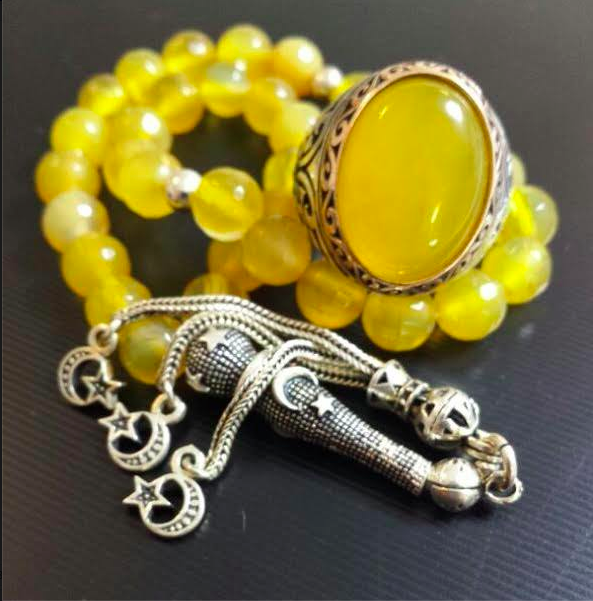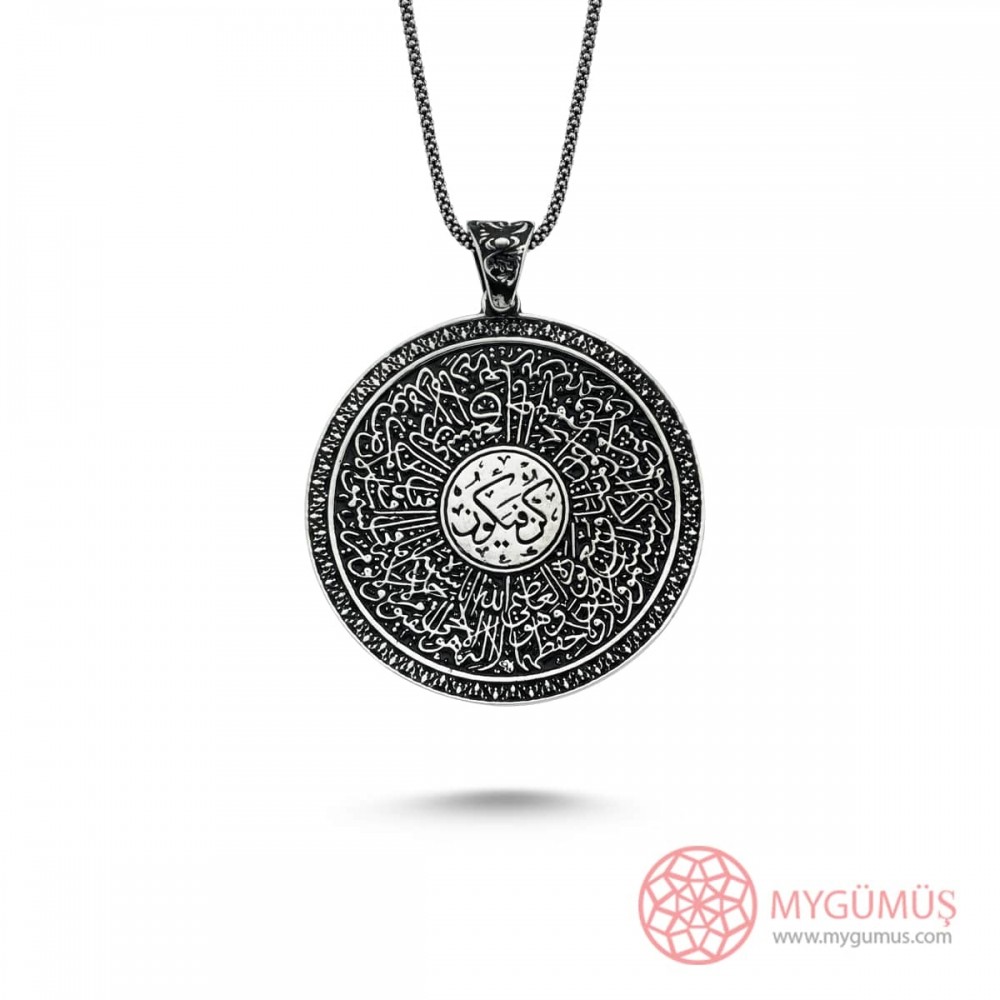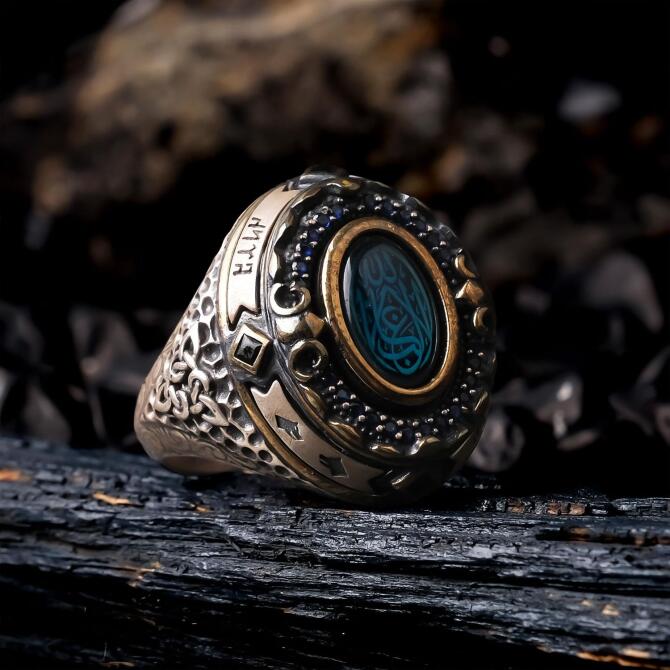
Grande Amor in İstanbul sells two silver rings at about 6,900 lira each. One has Hasbiyallah cut into a black stone: "God is enough for me." The other says La Tahzen: "do not grieve." Kuyumcuzade Silver in Konya has a ring at about 5,750 lira engraved in Turkish, Allah Bizimle Beraberdir, "God is with us." The last two are quoting the same verse. Lā taḥzan, inna Allāha maʿanā is Qur'an 9:40, what the Prophet said to Abu Bakr in the cave during the flight to Medina. One shop engraved the first half in Arabic, the other the second half in Turkish.
The stone in all three is akik, the Turkish form of the Arabic ʿaqīq. In English, agate. Prices are as we last read them, and the jeweller's own page is the one that counts.
How common it is
Search our catalogue for akik or agate and you get about 800 listings from 40 shops. More than half, about 425, are rings, and about 200 of those say erkek, men's, in the title. After rings come necklaces (about 190), bracelets (about 90), earrings (35) and 28 tesbih, prayer-bead strings. A man's silver ring with an oval agate is about as ordinary in a Turkish silver shop as a signet ring is in England.
Most titles don't name a colour at all. When they do, green leads with 72, then red (kırmızı or kızıl, 41), blue (22), yellow (20), black (17), pink (14) and brown (11). And 75 listings, from 7 shops, say Yemen. That word does most of the selling in this corner of the market, so most of this piece is about it.
What agate is, and what's been done to it
Agate is chalcedony: quartz made of crystals too small to see, usually laid down in bands. It is hard enough for daily wear, around 7 on the Mohs scale. It is also slightly porous, and a porous stone takes dye.
Dyeing agate is an old, open trade practice, and most agate on the market has had something done to it. Gemmologists take a few things as standard:
- Black agate (and most "black onyx") is nearly always dyed. The usual method soaks pale agate in a sugar solution and then in acid, which turns the sugar to carbon inside the stone. A ring sold as "siyah akik" at an ordinary silver price is almost certainly treated.
- Bright green and bright blue agate are usually dyed. If the green looks like a traffic light, it didn't come out of the ground that way.
- Red and orange, what English calls carnelian, is often heated. Heat turns iron compounds already in the stone redder. Some red stones are dyed instead. Some are natural. You can rarely tell by eye.
A treated agate is still agate. The common treatments, sugar-and-acid blackening and heating, are permanent; some of the more vivid dyes, especially bright blues, pinks and purples, can fade after long exposure to sun. The problem is not the treatment but that it goes unmentioned, and in the US the Federal Trade Commission's Jewelry Guides expect sellers to disclose treatments. Of the roughly 800 titles, not one mentions dye, heat or a certificate, with a single exception that goes the other way: Taş Sandığı labels one rough necklace Boyasız Akik, undyed agate. Meanwhile 175 titles say doğal, natural, which in Turkish shop language usually means "a real stone, not glass or plastic", not "untreated". Read it that way and it's mostly true. Read it as a promise about colour and you'll be disappointed.
The Yemen label
Aqeeq and Yemen go together in the Arabic-speaking world and well beyond it. Yemen has a long reputation for carnelian and agate, and "Yemeni aqeeq" is the name many buyers ask for.
The catalogue shows how the word gets used in Türkiye. Of the 75 Yemen listings, 55 come from one shop, Osmanlı Pazar. Ten more are at FK Gümüş. FK Gümüş sells Sarı Yemen, yellow, and Beyaz Yemen, white. Osmanlı Pazar has Kızıl Yemen, red, Kahverengi Yemen, brown, and Koyu Yemen, dark. Twelve titles add orjinal, orijinal or gerçek, "original" or "genuine". When a word covers white, yellow, red, brown and dark stones, it's no longer describing one material. My guess is that in the Turkish trade it now works partly as a grade or a style, the way "Persian" can on a rug. I can't prove that, and I don't think the shops are lying; they use the word the trade uses.
What I can say is that nobody can see "Yemen" in a stone. Agate from Yemen, India, Brazil or Botswana is the same mineral, and a standard gem lab report will identify chalcedony, and may note dye, but I wouldn't expect one to name a country. Some shops do name other origins. Dergah Tesbih sells a Hint Akik string, Indian agate, and Tesbihci Baba and Tesbih Rüyası sell Botswana agate prayer beads. Those labels are no easier to verify.
Is there a premium for the name? A small one. Among agate rings with a lira price, the 66 Yemen rings have a median of about 4,300 lira. The rest have a median of about 3,300. If origin matters to you for religious reasons, ask the shop where they buy their stones and how they know. A good answer names a supplier and admits what it can't prove. "It's original" is not an answer.
What's written on the stone
Among the rings, 64 have titles that say yazılı, inscribed, or kazıma, carved. The phrases come back again and again: Hasbinallah ve ni'mel vekil, "God is sufficient for us, and the best guardian" (Qur'an 3:173), which turns up in 7 listings from 2 shops; Ya Hayyu Ya Kayyum, "O Ever-Living, O Self-Sustaining"; the Kelime-i Tevhid, the declaration of faith; the names of the Prophet's family. Then the six- or eight-pointed star called Mühr-ü Süleyman, the Seal of Solomon, on 32 agate listings from 3 shops. Osmanlı Pazar also cuts vefk, number squares and letter grids from the talismanic tradition.
For some people an aqeeq ring is close to a religious practice. There are narrations recommending it, but many Sunni hadith scholars graded them weak or worse, while Shia tradition gives them much more weight. The stone is also credited with calming, protection and luck. I'm reporting those as beliefs people hold, not properties of quartz. If a seller is pricing in the protection, you're paying for a story.
A few practical points about the engraving:
Hand-cut or machine-cut. Sixteen titles say el kazıma or elde kazıma, carved by hand. Laser and rotary-machine lettering on agate usually looks evenly frosted and evenly deep. Hand-cut letters vary a little, and with a loupe you can see the tool marks. Neither is wrong, but they are different prices.
Ask which way the text reads. A seal is cut in mirror image so it prints correctly in wax. A ring meant to be read on the hand is cut the right way round. If you want a working seal, ask.
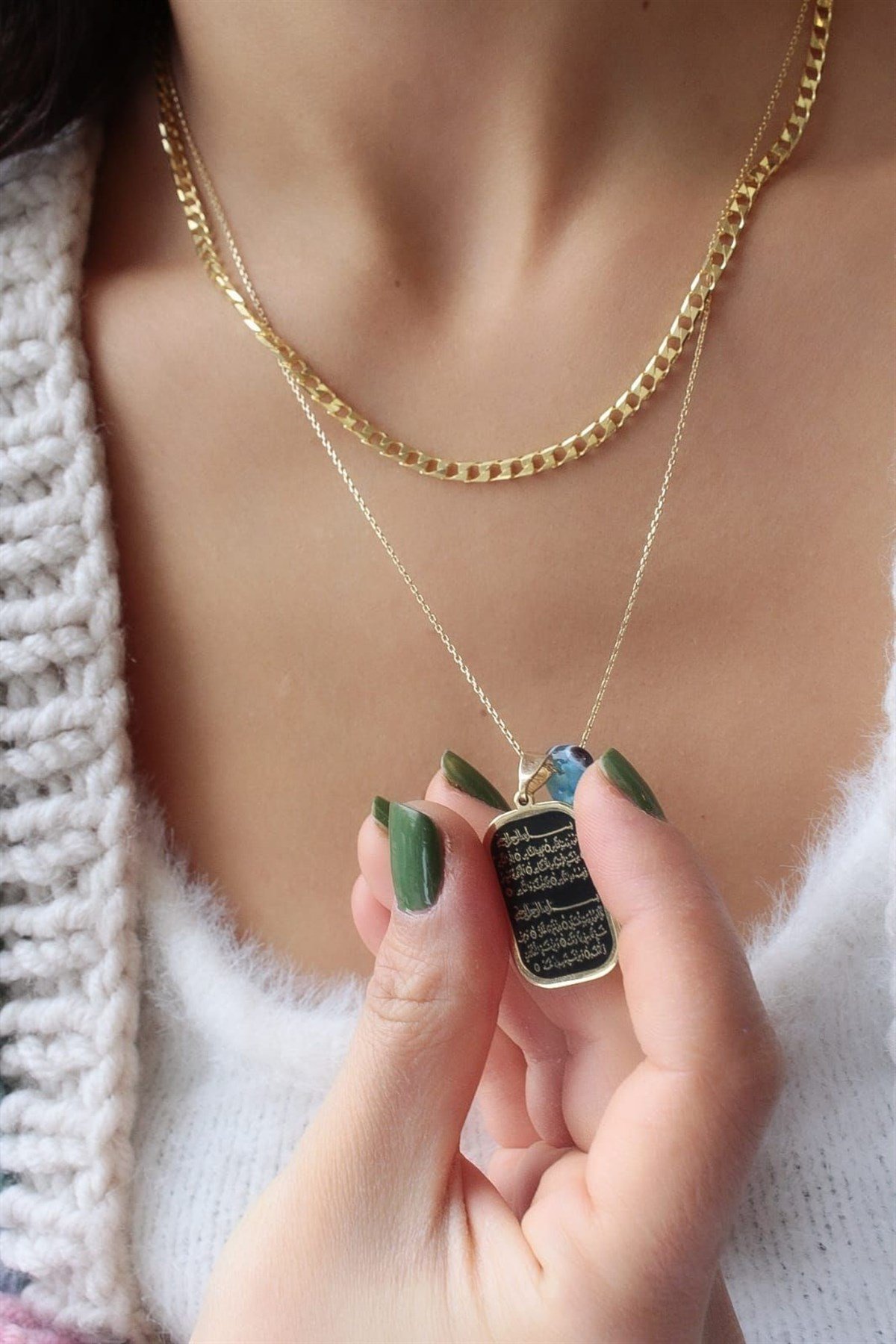
Think about where it goes. Verses on jewellery raise questions of etiquette, mainly bathrooms and ritual purity. We've written about that separately for Ayat al-Kursi pieces, and the same thinking applies here. Osmanlı Pazar sells an Ayat al-Kursi ring on Yemen agate.
Where the money goes
The most expensive agate pieces in our catalogue aren't silver at all. Nusret Takı sets agate in 24-karat gold, and its rings go up to about 157,300 lira. In silver, the ones that stand out are four rings at Osmanlı Pazar at around 32,500 to 33,100 lira, against a median of about 4,300 for the Yemen rings. Three say Yemen, three are described as Erzurum kalem işi, hand-chased metalwork, and three credit a master the shop names as Nurullah, with the surname spelled two ways, Daşdan and Daştan. That premium is for the silversmith, not the stone. Agate is cheap. Taş Sandığı sells black agate drop pendants for about 140 and 160 lira. Whatever you pay for an akik ring beyond that is silver, cutting, engraving and the maker's hand.
Check the 925 stamp, the weight, and how cleanly the bezel holds the stone. Look at the letters under magnification.
Four questions for the jeweller
- Is the colour natural, heated or dyed?
- When you say Yemen, how do you know?
- Is the engraving hand-cut or machine-cut?
- Is the text cut to be read, or as a seal?
A shop that answers the first one plainly is worth coming back to. Unlike amber or oltu stone, agate is rarely faked, because the real stone is cheaper than the effort of copying it. So the stone is the least of what you are buying. On a 4,000-lira aqeeq ring you are paying mostly for silver and for someone's lettering, and the lettering is where these rings differ most. Before you choose by colour or by the word Yemen, put a loupe on the letters.