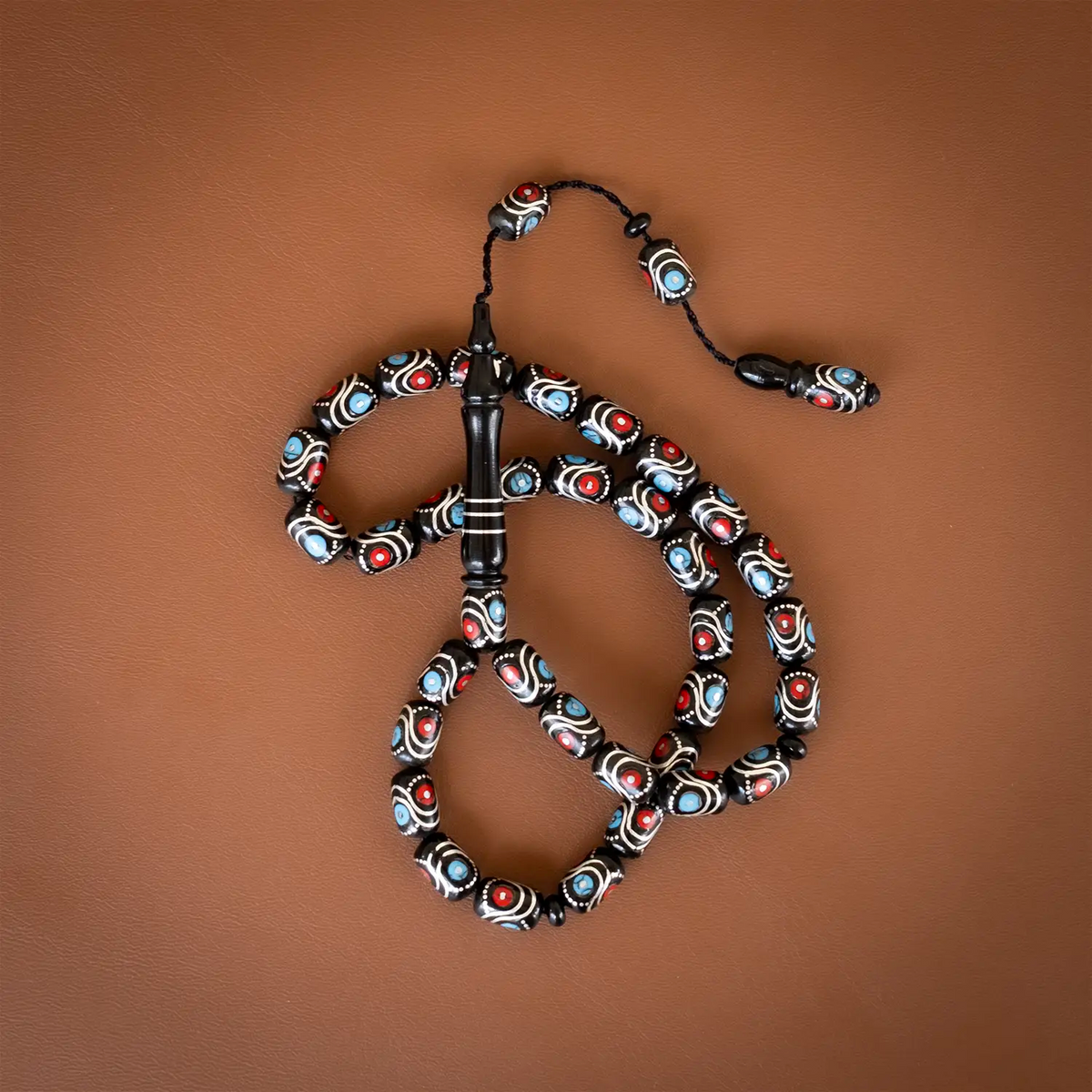
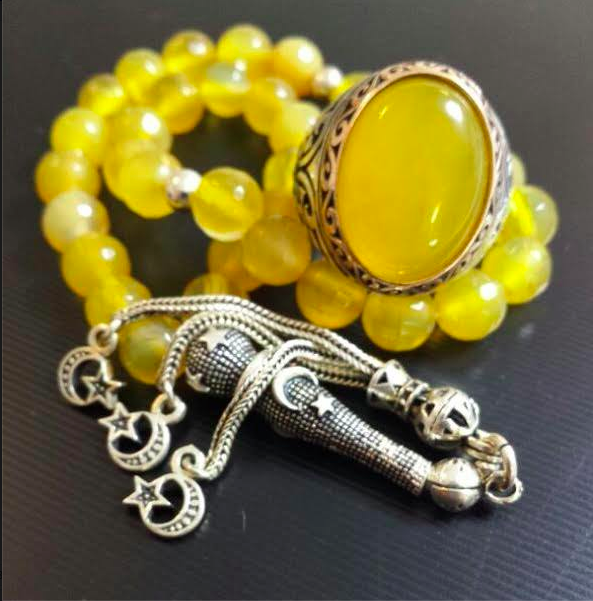
The most expensive prayer beads in our catalogue cost 459,000 lira. They are at Tesbihci Baba, listed as İskender Ustadan Osmanlı Kehribar Tesbih — an Ottoman amber tesbih from a named master. Tesbih Rüyası has a Lithuanian amber string at 35,000 and Ukrainian ones at 14,000 and 16,000. Meanwhile Turk Style Shop sells something also called kehribar for 44.90 lira. Every one of those listings uses the same word. All prices here are as we last read them and they move constantly; the jeweller's own page is the only one that counts.
That spread — four orders of magnitude under one word — is the whole problem with buying amber from Türkiye, and it is not mainly a fraud problem. It is a vocabulary problem. Most Turkish sellers are describing their material accurately. They are describing it in Turkish trade language that nobody translates for you.
Baltic amber, and why a Turkish shop is selling it
Amber is fossilised tree resin. The commercial supply comes overwhelmingly from one deposit region around the southeastern Baltic — Kaliningrad, Lithuania, Poland — with Ukraine as the other major source. Türkiye has no amber deposits of any commercial consequence. Every gram of real amber in an Erzurum tesbih shop was imported.
Which is why the good listings name a country. Across our 1,114 amber listings, eleven say Ukrayna and four say Litvanya. A seller who writes the source is telling you they bought rough from a named supplier. A seller who writes only kehribar may be telling you nothing at all.
Amber is soft — a steel blade bites it easily — which is exactly why it became a bead material. You turn it on a small lathe, one bead at a time, the way Erzurum turns oltu taşı. The two materials share the qualities that actually matter in the hand: very light for their size, and never cold to the touch.
The words on the label
Damla kehribar — literally "drop amber". In practice this is the trade's term for natural amber, and it is the term carrying the high prices. 287 of our listings use it.
Sıkma kehribar — "pressed" or "squeezed" amber. 233 listings. Small fragments and offcuts of genuine amber are heated under pressure until they fuse into a workable block. This is real amber. It is also not the same product as a bead cut from a single natural piece, and it should never cost the same. The distinction is standard in the international trade too, under names like pressed, reconstituted or ambroid.
The honest bit: pressed amber is not a scam. It is the reason a 33-bead amber string can exist at a few thousand lira instead of a few hundred thousand. Oltu Taşı Market's pressed strings sit around 1,150 lira; İpek Silver's pressed-amber Seljuk eagle rings around 8,100. Those are fair prices for what they are. The scam is only ever selling pressed as natural.
Ateş kehribar — "fire amber", 256 listings, named for a bright glowing translucency rather than for an origin. It is not a separate material category, and you can prove that from the listings themselves: 33 of ours read Sıkma Ateş Kehribar — pressed fire amber. The name describes a look. In parts of the Turkish tesbih trade the same phrase also gets attached to mid-twentieth-century phenolic resins, which are plastics with their own serious collector following and their own real prices. I cannot tell you from a product title which of the two any given "ateş kehribar" bead is, and neither can anyone else. Ask the shop directly before you buy.
Bal is honey colour, sarı yellow, kırmızı red, lacivert navy, yeşil green. These are colours, not grades. Navy and green generally mean treated or pressed material; natural amber does not come out of the ground looking like that.
Fosilli means visible inclusions — trapped bubbles, debris, plant matter. 48 listings. Inclusions are a genuine premium in natural amber, and they are also faked routinely, including inside pressed blocks.
Which tests actually prove something
Saltwater flotation. Dissolve salt into water until no more will go in, then drop the bead. Amber is barely denser than water and floats in saturated brine; most dense plastics sink. This is the best home test, with four caveats nobody mentions. Pressed amber floats exactly like natural amber, so this separates amber from heavy plastic and nothing more. Light plastics float too. Any bead with a silver cap or a mount will sink whatever it is made of. And do it with one loose bead — never lower a strung tesbih into salt water, which will wreck a silk cord, mat the tassel and tarnish the silver. Rinse and dry the bead properly afterwards.
UV light. Baltic amber fluoresces a bluish tone under longwave UV. So does pressed amber. So does copal. So do several plastics, and some resins are manufactured to. Treat a completely dead, inert response as a reason to ask more questions — not as a verdict either way.
The hot needle. Heat a pin, touch it to the drill hole. Amber smells of pine resin, copal smells resinous and softens sooner, most plastics smell sharp and acrid. It works. It also leaves a permanent mark, and on a mounted piece you can scorch the setting. Never do this to something you are only considering buying, and think twice before doing it to something expensive you already own.
Acetone on a cotton bud. Copal — young, partly fossilised resin, the most convincing natural-looking substitute — goes tacky within seconds. Amber does not. It also dulls a polished surface and dissolves the adhesive under a glued or bezel-set stone, so keep it to a loose bead or the flat underside of the imame — the large tapered head bead that closes the string — and never put it near a mounted one.
Rubbing it for static. The Greek word for amber, ēlektron, gave us "electricity" precisely because the stuff takes a charge when rubbed. Historically true, charming, and useless as a test: plastics do it better.
For pressed amber specifically, none of the above helps, because it is amber. What helps is a loupe. Look for boundary lines where separate fragments were fused, for cloudy stringy flow structure, and for colour that is too uniform bead to bead across a whole 99-bead string. Natural material varies. Definitive identification is a laboratory job — infrared spectroscopy — and serious dealers can produce paperwork. 46 of our amber listings mention a certificate.
Buying, and one thing not to buy
Amber runs through prayer beads above all — 542 of these listings are tesbihs — but it also turns up set into heavy silver men's rings (just under 300 listings, median around 6,700 lira), and in Ottoman-motif bracelets and pendants. Whatever the form, the silver around it should still carry a 925 stamp.
One exception. 40 of our amber listings are baby teething necklaces. I would skip those. In 2018 the US Food and Drug Administration issued a public warning against amber teething jewellery, citing choking and strangulation, and advised parents not to use it. Whether the amber is real has nothing to do with that risk.
If you want amber to hold rather than to insure: pressed, honestly labelled as pressed, 33 beads, silk tassel, from a shop that sells nothing but tesbih. It warms to your hand in about a minute, and that is most of the point of the material.