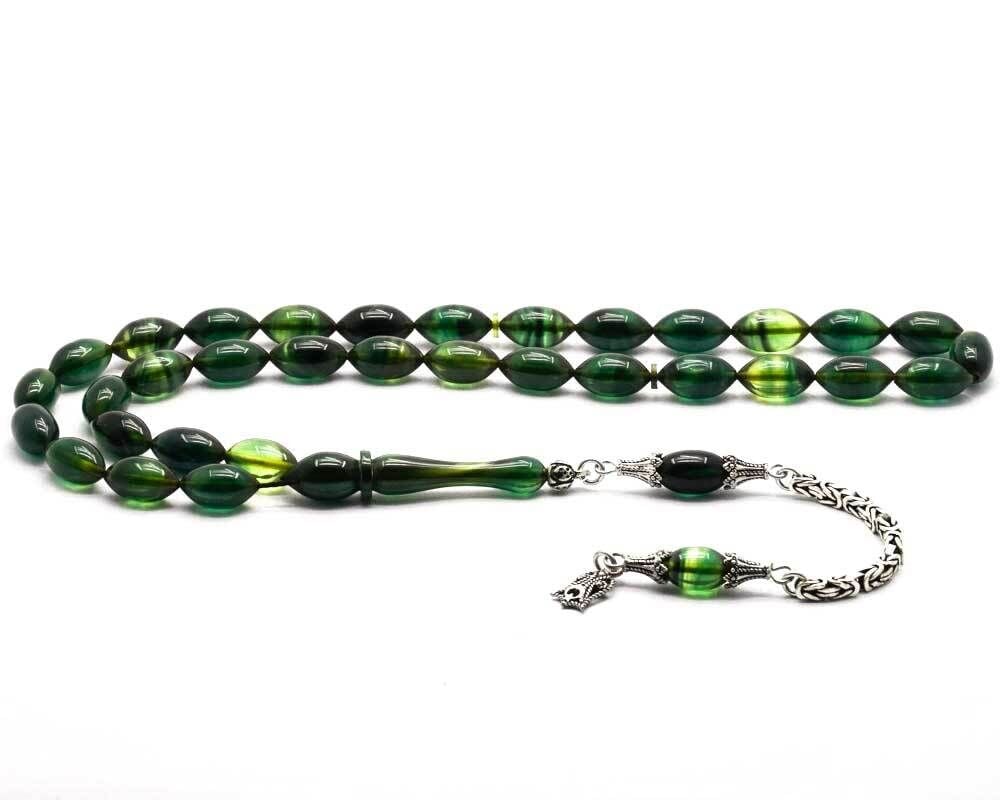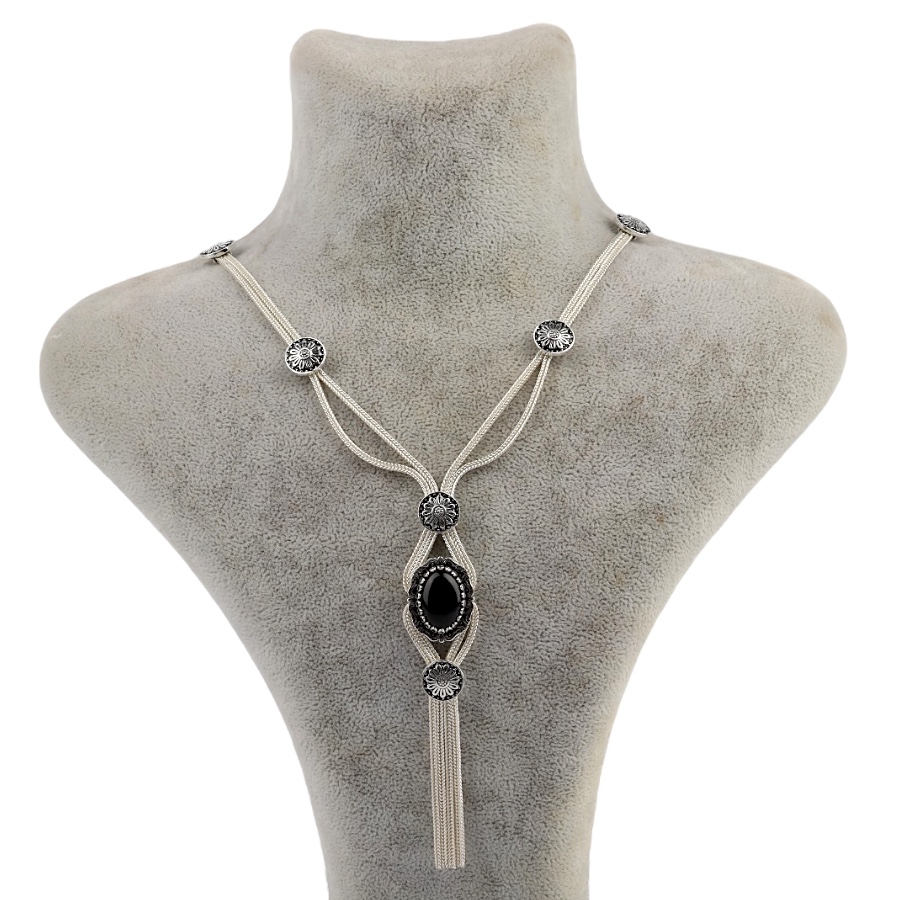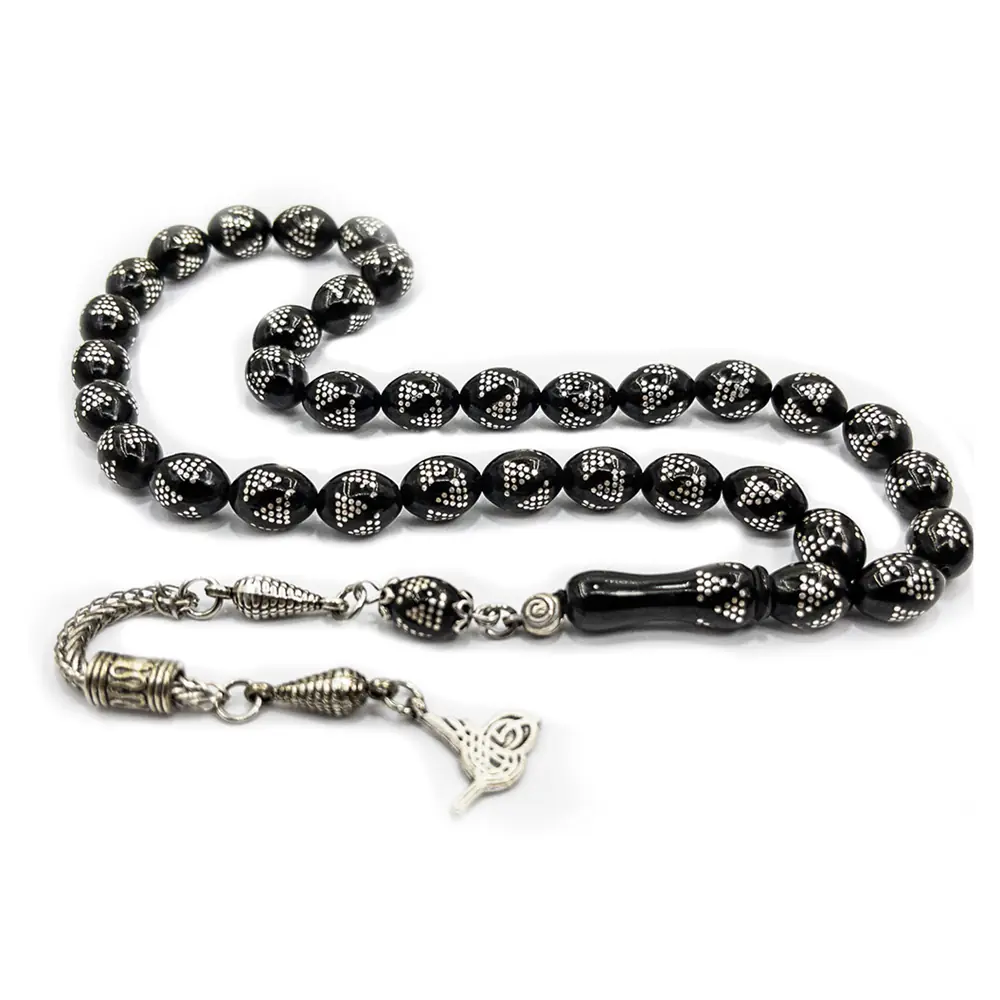
Prayer beads are the largest single thing in our catalogue after rings. Counting by category, there are about 1,180 tesbih listings across the 78 jewellers, and two shops in Erzurum — Taşhan Erzurum and Tesbih Pasajı — account for 576 of them between them — just under half. That is not a coincidence of scraping. Erzurum is 1,900 metres up in the northeast, cold most of the year, and it happens to sit next to the only place in the world that produces the material this whole craft is built around.
What a tesbih actually is
Tesbih (say tess-BEE) comes from the Arabic root for glorifying God. The object is a counting tool. After each of the five daily prayers, a common practice is to say subḥānallāh, alḥamdulillāh and Allāhu akbar thirty-three times each — hence the standard 33-bead string, run three times round. The 99-bead version does the whole circuit in one pass and is usually associated with the ninety-nine names of God, though people use it for any count they like.
Turkish tesbihs are not rosaries and the parts have their own names, which sellers rarely translate:
İmame — the long, tapered head piece where the two ends of the cord meet and the knot hides inside. This is where you look first to judge a maker. It is a single piece of stone or wood, drilled the full length with two channels that have to meet cleanly inside, on a lathe, without splitting. A crooked imame on an otherwise pretty string tells you everything.
Püskül — the tassel hanging below the imame. On better pieces it is silk or fine cotton, wrapped at the neck with metal thread, sometimes in the kazaziye technique (fine wire woven over a core, a Trabzon speciality). Cheap tassels are synthetic and go stringy within a year.
Durak or nişane — the marker beads dividing the string into thirds, so you can feel where you are without looking.
Kamçı — the "whip", the short tail below the imame on some designs, purely for handling and flourish. Search that word in a listing and you will usually find a piece made for the hand rather than for prayer.
Oltu stone
Oltu is a district in Erzurum province. The stone named after it — oltu taşı, sometimes sold in English as Erzurum jet or black amber — is a form of jet: a very compact, fossilised woody material in the lignite family, laid down under pressure over an extremely long time. It is coal, essentially, but coal that behaves like a gemstone.
Three properties explain the obsession.
It is light. A 99-bead oltu string weighs a fraction of the same string in onyx or obsidian, which matters if you are holding it for an hour.
It is warm. Pick up a glass or stone bead and it pulls heat from your fingers. Oltu does not. It comes to skin temperature almost immediately and stays there. Anyone who has handled both can do this test blind.
It takes a polish that goes deep. Cut and worked properly, the surface is not shiny-on-top like lacquer; it has a soft, almost liquid black that seems to sit slightly below the surface.
It is also soft — you can scratch it with a fingernail if you are determined — which is why it is turned by hand on small lathes, a bead at a time, rather than tumbled in a barrel. That softness is also why silver mounts are so common on oltu tesbihs: the metal takes the knocks.
In the catalogue, 448 prayer-bead listings carry "oltu" in their product name, and 308 of those are from Taşhan Erzurum alone. Named oltu pieces run from a few hundred lira for a simple round-cut string up to the high tens of thousands for silver-inlaid collector work — roughly, and only as of when we last read the pages. Prices move and the jeweller's own site is the only one that counts.
The other materials, briefly
Kehribar (amber) is the other prestige material, and the most abused word in the trade. True Baltic amber is fossil resin, warm and light like oltu, often with internal flow lines or bubbles. What is widely sold as amber in the tesbih world is sıkma kehribar — pressed amber, real amber powder heat-fused into blocks — and, further down, phenolic resin, which is a mid-twentieth-century plastic with its own genuine collector following and should be described as such rather than as amber. Read the listing carefully. Roughly 300 of our prayer-bead listings mention amber in the name; how many of those are pressed rather than natural is not something a title field can tell you.
Kuka is the hard nut of certain palms, dense, dark, and it develops a patina from skin oil that people wait years for. About seventy listings. Underrated, cheap, and the best first tesbih for someone who wants to actually use one.
Gümüş (silver) shows up as full silver strings, as inlay into oltu, and as the collars and imame caps. A fully silver tesbih is heavy and loud in the hand, which some people want. Whatever the mount, it should carry a 925 stamp somewhere — on the imame cap or the collar — and the ordinary ways of checking that apply here as much as anywhere.
Telling real oltu from an imitation
Moulded black plastic beads are everywhere, and at a distance they look identical. Four things, from least to most invasive:
Temperature, again. The fastest test and the one no plastic quite fakes. Plastic warms up too, but it gets there differently — a slightly sticky warmth rather than oltu's dry neutrality. Hold a known plastic bead in one hand and the piece in question in the other.
Weight against size. Oltu is very light, but plastic is lighter still and it feels hollow rather than light. A large oltu bead has a faint density to it; a large acrylic bead has almost none.
The drill holes and the seam. Moulded beads have a parting line where the two mould halves met, usually running through the equator between the holes. It gets polished, rarely perfectly. Turned oltu shows fine concentric lathe lines under magnification if it has not been over-polished, and never a seam.
Streak. Jet leaves a brown streak when drawn across unglazed porcelain — the back of a bathroom tile works. Black plastic leaves nothing, or a smear. Do this on the imame's flat bottom, not on a visible face, and be aware that you are abrading a real object to prove that it is real.
The old test — a hot needle to the surface, coal smell for jet, chemical smell for plastic — works, and it also permanently marks the piece. Skip it unless you already own the thing and are curious.
One habit that serves better than any test: buy from a shop whose whole inventory is prayer beads. A generalist jeweller with four tesbihs in the window is reselling. A shop with two hundred, sorted by cut and by bead diameter, is not. The prayer beads collection is sorted so you can see which is which. Every piece links out to the jeweller's own site, which is where the live price is. Anything quoted second-hand, ours included, is approximate.
If you want one to hold rather than one to photograph: 33 beads, kuka or plain-cut oltu, 8 or 9 millimetres, silk tassel. The enormous inlaid showpieces are impressive and they stay in the box.