Filter our catalogue for rings whose title carries the word zihgir or archer ring and you get 46 pieces, spread across eight jewellers, every single one of them filed under rings. Forty-one of the forty-six say silver somewhere in the name. One says gold. That ratio is the first thing worth knowing about this object: it is a men's silver category in the Turkish market today, and it did not start out as jewellery at all.
It was a tool, and a boring one
European archers draw a bow with two or three fingers hooked over the string. Turkish, Persian, Mongol and Chinese archery mostly does something else — the thumb hooks the string, the index finger locks over the thumbnail, and the whole draw weight of the bow lands on one joint and one pad of flesh.
A Turkish composite bow is short and unreasonably stiff. Put sixty or a hundred pounds of tension on a bare thumb and two things happen: the string cuts, and the release is inconsistent because your thumb flinches before your mind does. The zihgir (say zih-GEER; from Persian zih, bowstring, plus gir, holder) solves both. It is a ring that sits at the base of the thumb with a broad tongue extending up over the pad. The string rests on the tongue. The thumb underneath feels pressure but not the edge.
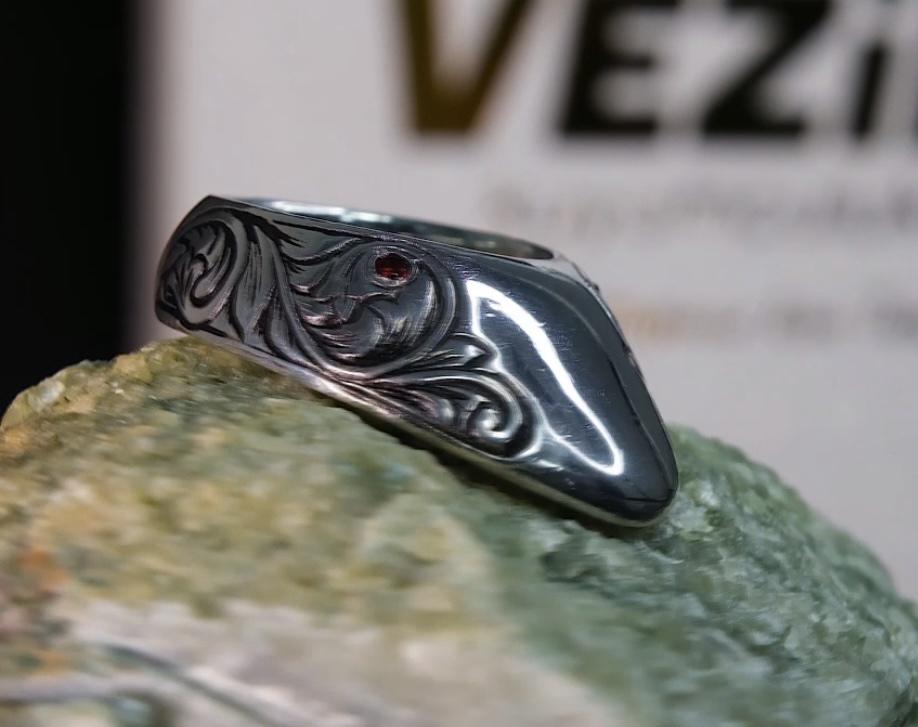
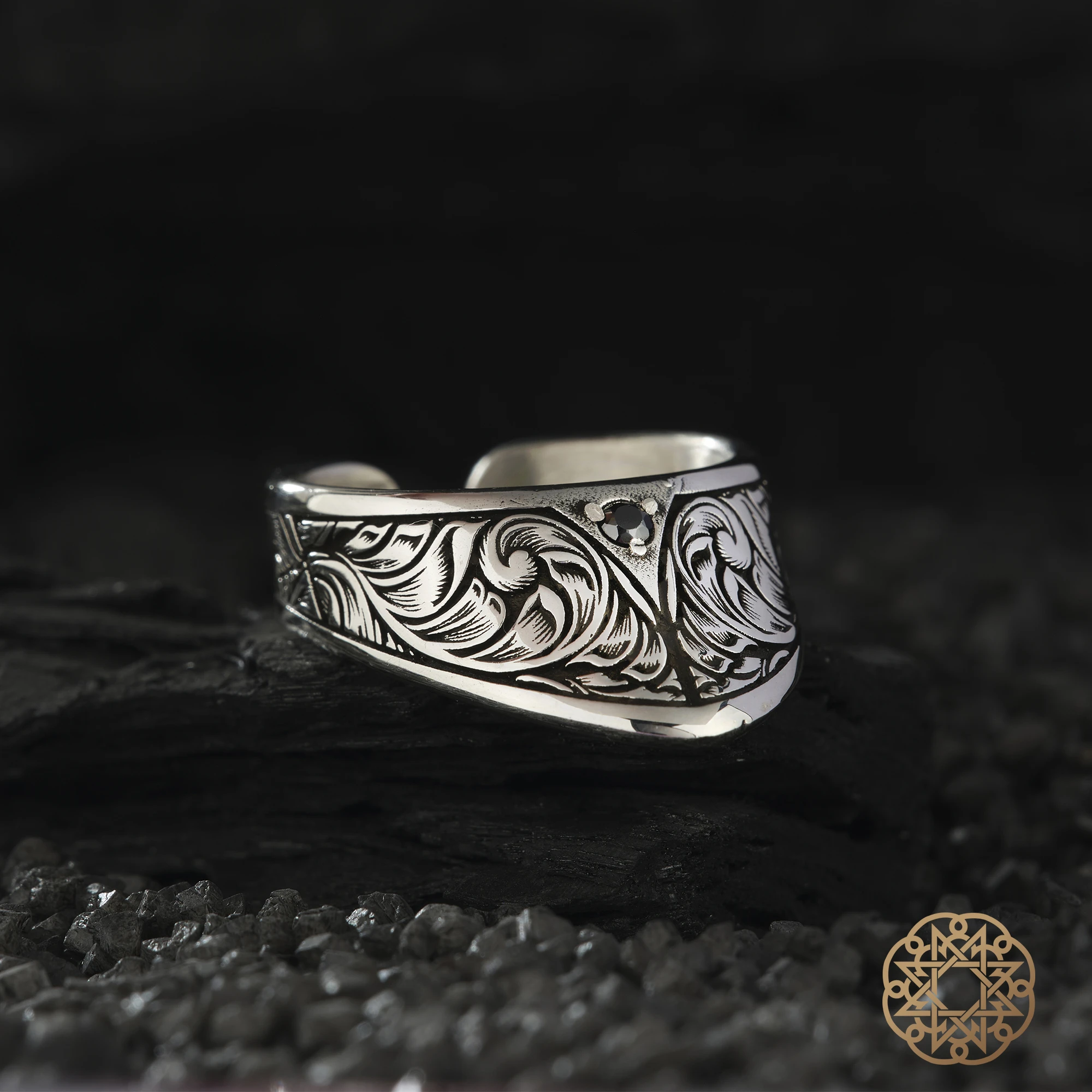
That tongue is why the shape looks so strange to anyone meeting it cold. It is not a decorative flare. It is a bearing surface, and its lip or shallow groove is where the string parks so it cannot creep during a long hold. On release the string rolls off a polished curve instead of dragging over skin, which is the difference between an arrow that goes where you looked and one that goes somewhere near there.
Worth saying plainly: the good ones were shaped to a specific hand. A zihgir that is loose rotates under load, and a zihgir that is tight cuts off the thumb before you have drawn twice.
How a piece of kit became a rank
Ok Meydanı — the Arrow Field — was Istanbul's archery ground, with a lodge and a tradition of setting stone markers where record shots landed. Ottoman flight archery was competitive, formalised, and patronised at the very top; sultans shot, and Mahmud II in the early nineteenth century is the one most often named as a serious practitioner and reviver of the sport. (The distances recorded on those stones get quoted constantly in modern articles. The unit involved, the gez, does not convert cleanly, and we would rather not hand you a number that other people are still arguing about.)
Once the elite shoot, the equipment stops being equipment. Working zihgirs were horn, ivory, bone, hardwood, sometimes jade — materials chosen because they are hard, slick, and do not gall a bowstring. Court zihgirs were gold, set with stones, and in some cases so encrusted they could not have survived a real draw. Topkapı Palace in Istanbul holds examples in that second category. They are insignia wearing the costume of a tool, the way a ceremonial sword is not for cutting.
This is the part most listings skip, and it changes how you should read a modern one. A silver zihgir with a tuğra or a verse cut into the tongue is not a replica of a shooting ring. It descends from the court version — the badge, not the gear.
What the engraving usually says
Going through the titles in our catalogue, the recurring motifs sort into a few groups, and they tell you something about who buys these.
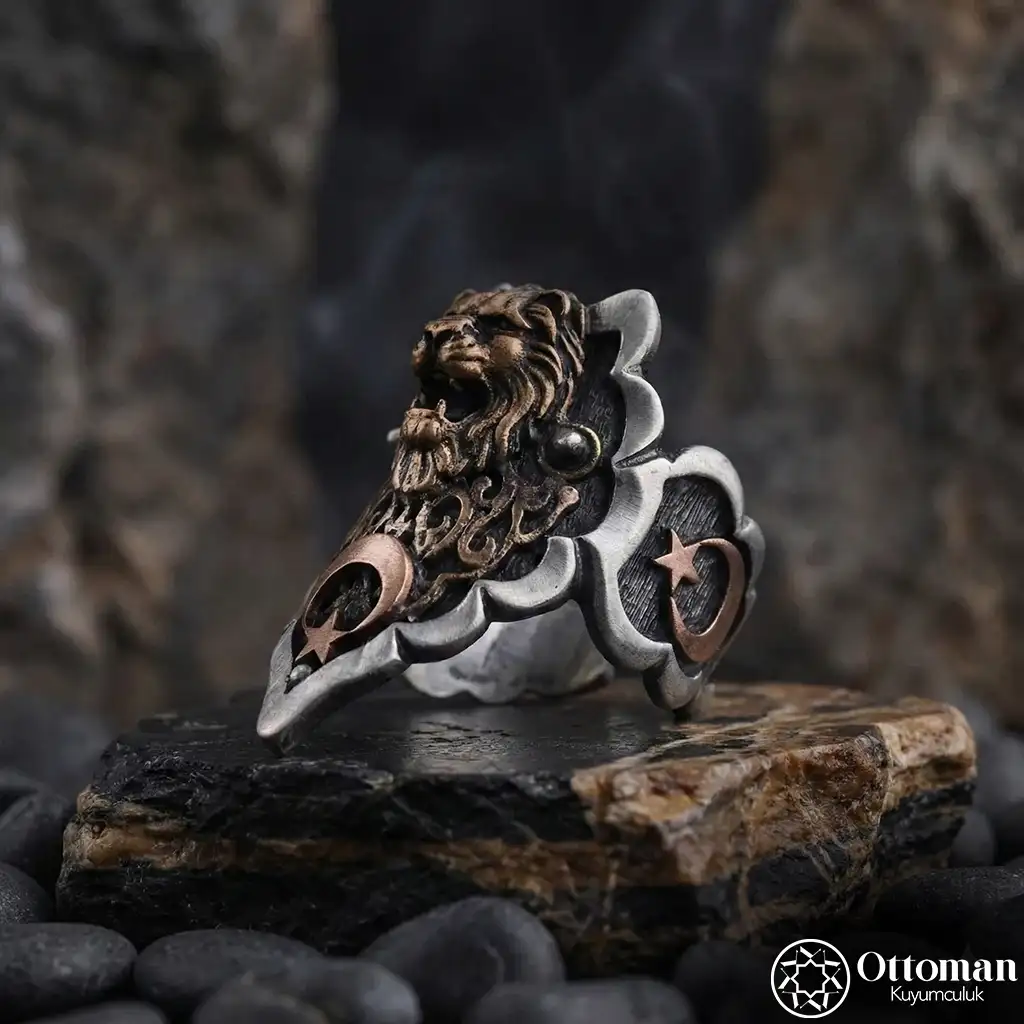
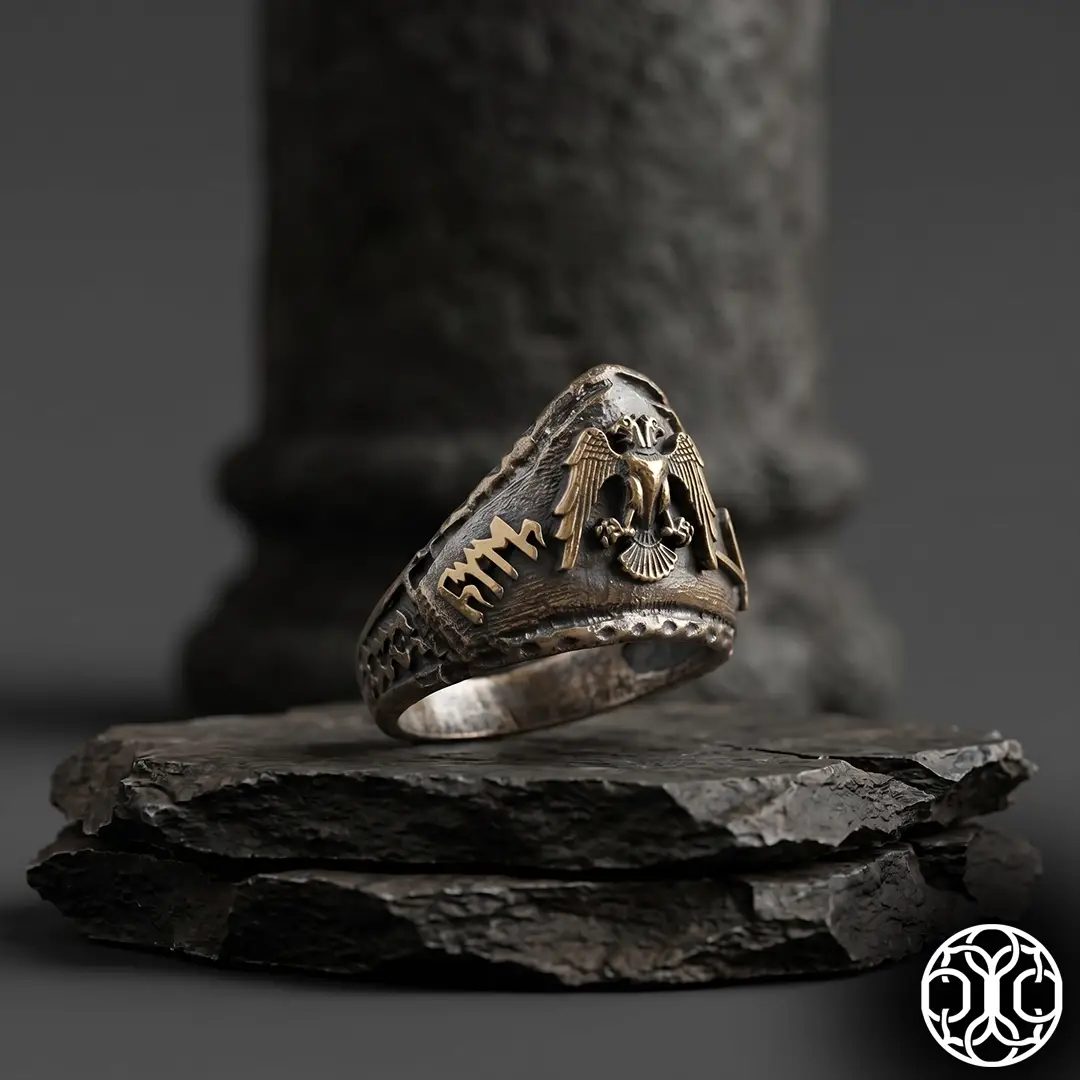
There is the Ottoman-imperial set: star and crescent, the double-headed eagle, the Seal of Solomon (Mühr-ü Süleyman), the occasional tuğra — the calligraphic sultanic monogram. There is the religious set: lā ghāliba illā Allāh, "there is no victor but God," which was the Nasrid motto and turns up constantly on Turkish men's silver; lā ḥawla, the opening of a longer formula of reliance on God. And there is the Sufi-flavoured one-word set, above all hiç — Turkish for "nothing," a word with a long life in dervish poetry and a favourite of Turkish calligraphers, who like that the letters can be composed into an almost architectural shape.
Then there are names and initials, which are a large chunk of the category and which we are not going to say anything more about, because engraving arrangements vary by workshop and we are not in a position to promise anything on a jeweller's behalf.
Buying one now
Most modern zihgirs are worn, quite simply, as a thumb ring, and the tongue points up the back of the hand toward the wrist. Turned the other way it looks wrong and catches on everything.
A few things we would actually check:
Sizing. Thumbs are not fingers. A thumb measures a couple of sizes larger than the same person's ring finger, it changes measurably with heat and altitude, and the wide band typical of this style fits tighter than a narrow one at the same nominal size. Measure your thumb, at the end of a normal day, not first thing in the morning.
The underside of the tongue. This is where cheap casting shows. The face gets polished and photographed; the back of the flare often does not. It sits against your skin all day. Run a fingernail along it.
Weight and the wearing problem. A heavy tongue extending off-axis gives the ring leverage to rotate. Some are honestly too front-heavy for daily wear, and nobody tells you that until you own one.
Whether it is actually a zihgir. A lot of wide men's thumb rings get filed under archer rings because the term sells. If there is no extended tongue over the pad of the thumb, it is a thumb ring. Fine object, different object.
Across the 46 pieces we have in this category, the listed prices ran from roughly 2,100 to 9,500 Turkish lira at the time our catalogue was last refreshed. Treat that as a rough band rather than a quote — silver moves. You can see the whole group in the archer ring collection. Every piece links out to the jeweller's own site, which is where the live price is. Anything quoted second-hand, ours included, is approximate.
The thing we like about them
Most historical jewellery available to a Western buyer is decorative in origin. This is not. It is a solved engineering problem — a specific answer to a specific injury, produced by an archery tradition that did the thumb draw better than anyone — which then got promoted out of usefulness into status and stayed there for a few centuries.
If you want the object at its most honest, look for a plain one. Clean tongue, no stones, maybe one word. It reads closer to what it was.