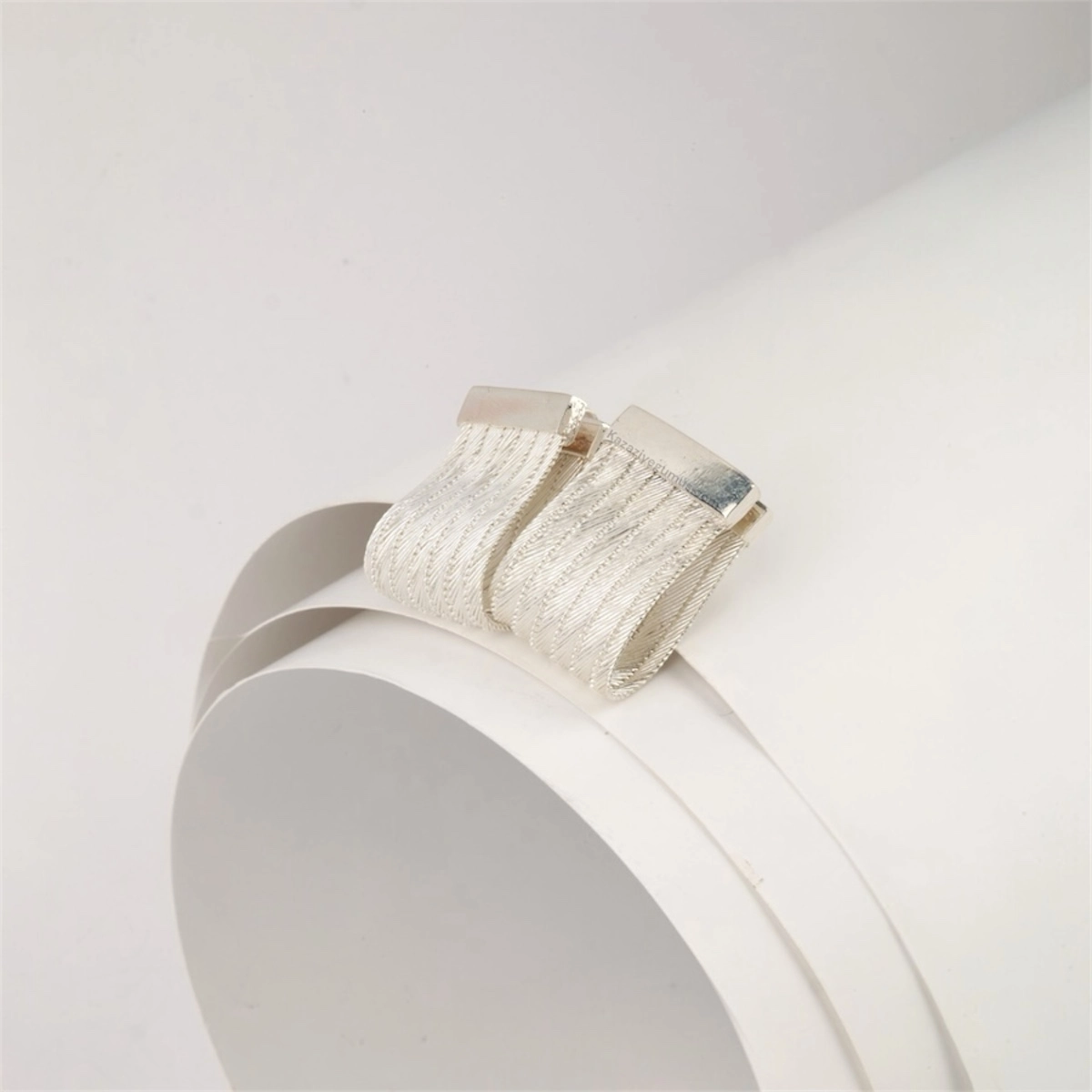
Pick up a Trabzon hasırı bracelet and the first thing you notice is that it behaves wrong. It looks like metal and it moves like fabric. A wide cuff drapes over the wrist bone instead of standing off it. A woven collar pours through your fingers. Nothing about the surface suggests that, because it reads as solid — a dense, matte-bright band with no holes in it anywhere.
That is kazaziye, and the reason it moves is that there is no sheet metal in it at all. The whole thing is thread.
Wire thin enough to lose
The craft starts the same way filigree does: a silver rod pulled repeatedly through a drawplate, a steel block with a graded row of holes, each pass making the rod longer and thinner. The Turkish geographical-indication specification for the craft puts the finished wire at 31 to 32 microns. For scale, a human hair runs roughly 50 to 100 microns. So the working thread is thinner than hair, and it is silver, and it is about to be handled for several days straight.
Purity varies more than you would guess. The geographical-indication specification names 900 silver. In today's shops most kazaziye is plain 925 sterling — of Kazaziye Gümüş's 600 listings, 373 say 925 and only 42 say 1000 ayar, fine silver at 999-plus purity, which turns up mostly on the heavier multi-row pieces. The reason to reach for fine silver is ductility, not bragging rights. Sterling's copper makes the wire springier, and springy wire kinks when you bend it around a form a thousand times. Fine silver is softer and takes the weave more forgivingly — which is why it shows up where the weave is densest. The trade-off is that the finished piece is softer than sterling and scratches more easily, which matters later when we get to care.
Then it gets woven. Not soldered into a lattice — woven, strand over strand, around a core, the way a rope or a flat braid is made. The Turkish name for the flat plaited version is hasır, which is the everyday word for a woven rush mat, the kind you put on a floor. There is nothing poetic about the name. Someone looked at the weave, saw a mat, and called it a mat. Bracelets get described by how many braided bands run side by side: a 9 sıra — nine-row — hasır cuff is nine of those plaits worked together into one wide band.
Because the structure is a weave and not a soldered skeleton, it flexes and returns. Because it is made of hundreds of thin round surfaces instead of one flat one, it scatters light softly from every angle rather than throwing a hard highlight. People call kazaziye "glowing." That is the mechanism.
How it differs from telkâri
English lumps both under "filigree," which is how most shoppers end up confused. The distinction is simple once you have seen the two side by side.
Telkâri builds an outline in heavier wire, fills the enclosed space with coils and spirals of twisted wire, and solders the whole assembly in one terrifying pass with a torch. The result is openwork. You see through it. It is rigid, it is light, and a side knock will crush it. Midyat and Mardin in the southeast are its home, and I went through that bench process here.
Kazaziye has no frame, no fill, and very little solder — just joins at the ends. It is dense and closed. You cannot see through it. It bends and springs back. Its home is Trabzon, on the Black Sea coast, about as far from Mardin as you can get and stay in Turkey.
The workshops themselves blur this. In our catalogue the two Trabzon houses — Kazaziye Gümüş and Trabzon Gümüş Kazaziye — account for the bulk of the true woven work, while İstanbul's Diriliş Kuyumculuk does Trabzon hasırı in gold. But several Midyat filigree shops also list pieces under the kazaziye name. Around eighteen shops in the catalogue use the word. Some of that is genuine woven work. Some of it is a filigree bench borrowing the more searchable term.
Where it comes from, and what nobody can tell you
The word kazaz comes from Arabic and means a worker in silk thread. That etymology is solid, and it is the most useful fact about the craft's origin, because it points at textile work rather than metalwork. The technique is a weaving technique applied to metal.
Everything past that gets slippery. You will find articles asserting that kazaziye reached Trabzon with Byzantine silversmiths, or with the Seljuks, or along the Silk Road — each stated with complete confidence and no source. I do not know which, and I have not seen evidence that settles it. What is beyond argument is that Trabzon is where the craft concentrated and where it still is.
Trabzon hasırı is a registered Turkish geographical indication. The record is held by the Trabzon Chamber of Jewellers and Watchmakers under the name Trabzon Telkariye ve Hasırı, registration no. 94, filed 22 September 2006 and published in the Official Gazette on 22 April 2007, with amendments in 2020 and 2024. It is a mahreç işareti — an indication of source, the looser of Turkey's two categories: the craft must be made in Trabzon to Trabzon's method, but unlike a designation of origin it does not require every input to come from the province. The registration covers gold and silver bracelets, necklaces, earrings and rings, and it specifies 916 gold (22 carat) or 900 silver drawn to that 31–32 micron wire, with commercial work running anywhere from 14 to 22 carat. This is real protection inside Turkey: it defines what the name is allowed to describe. There is no EU-level protected status, so "Trabzon hasırı" on a listing outside Turkey is not legally policed. It is a description, not a guarantee.
What the real pieces cost
Prices below are converted from Turkish lira at roughly 47 TRY to the dollar and will drift. The jeweller's own site carries the live number; treat these as orientation only.
Fine silver kazaziye starts genuinely cheap for handwork. A plain Trabzon hasırı ring from Kazaziye Gümüş runs around $40, oxidised earrings around $55, a fine silver necklace in the $65 to $75 range. That is real woven silver for less than a decent dinner out, which tells you how fast a practised weaver moves on a small piece.
Bracelets are where the labour shows up. Silver hasır bracelets from Kazaziye Gümüş, the one Trabzon shop in our catalogue that publishes prices, start near $105 at the narrow end, sit around $345 in the middle, and the widest multi-row cuffs push past $1,500. Width multiplies hours almost linearly. Nine rows is nine times the weaving.
Woven prayer beads are a category of their own. Takıhan lists hand-woven kazaziye tesbih in the $250 to $415 band, and every single bead there is separately wrapped.
Gold is a different world. Diriliş works Trabzon hasırı in 8K, 14K and 22K: a 14K cuff lands near $3,000, a 22K nine-row set somewhere around $13,000 to $14,500. At that level you are buying bullion plus several weeks of one person's hands.
Buying and wearing it
Turn the piece over. On genuine woven work the reverse looks like the front, because a weave has no wrong side. Stamped or cast imitation hasır gives itself away underneath: a flat, slightly blurred back, sometimes with a seam where a hollow tube was closed. Cast copies also feel dead. No give at all.
Check the clasp and the end caps, because that is where kazaziye fails. The weave itself is remarkably durable; the soldered terminals and the hinge are the stress points. On a wide cuff, ask whether the band is woven over a core or hollow. Hollow is lighter, cheaper, and dents.
Ask the weight before ordering. Fine silver is dense and a nine-row cuff is a substantial object on the wrist. Turkish shops usually state grams on the listing; if the page doesn't, message them.
Care, briefly. Fine silver tarnishes, and here it tarnishes down inside a weave you cannot reach. Do not attack kazaziye with a polishing cloth — you will burnish the tops of the strands and leave the recesses dark, which looks worse than even tarnish. Use a silver dip, or a warm bath with a drop of dish soap, agitate gently, rinse well, and dry with a hairdryer on cool instead of rubbing. Get the water fully out of the weave or it sits there. Oxidised black-and-white pieces are the exception: an aggressive dip strips the deliberate blackening, so soap and water only.
Take it off for the gym and for the sea. Fine silver is soft enough that one hard scrape marks it for good, and a flattened section of weave is the one thing that cannot be polished out.
The whole kazaziye collection links straight out to the workshop that made each piece. If you are starting, start with a ring or earrings. Cheap enough to be a low-stakes way of finding out whether you like how the stuff moves.


