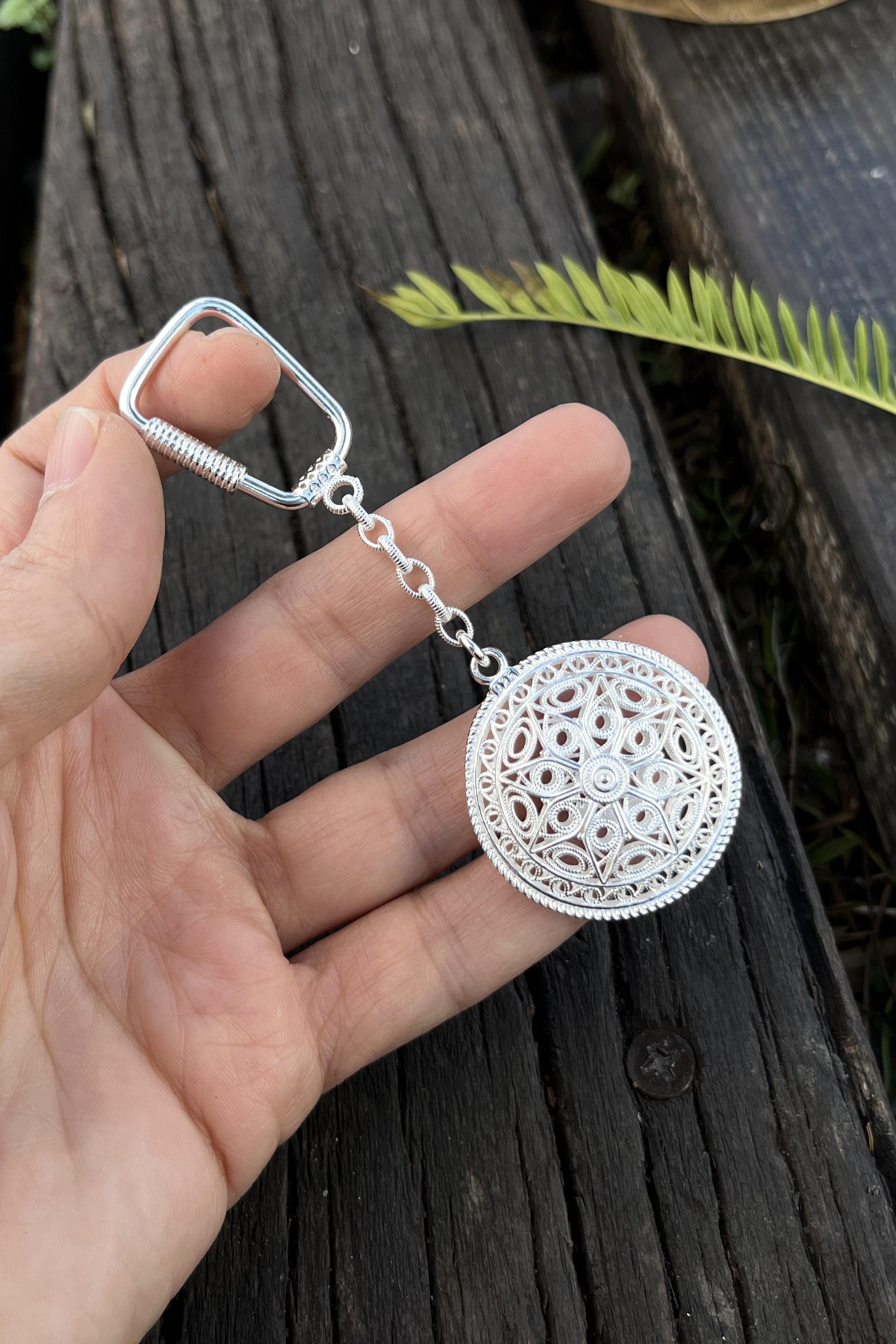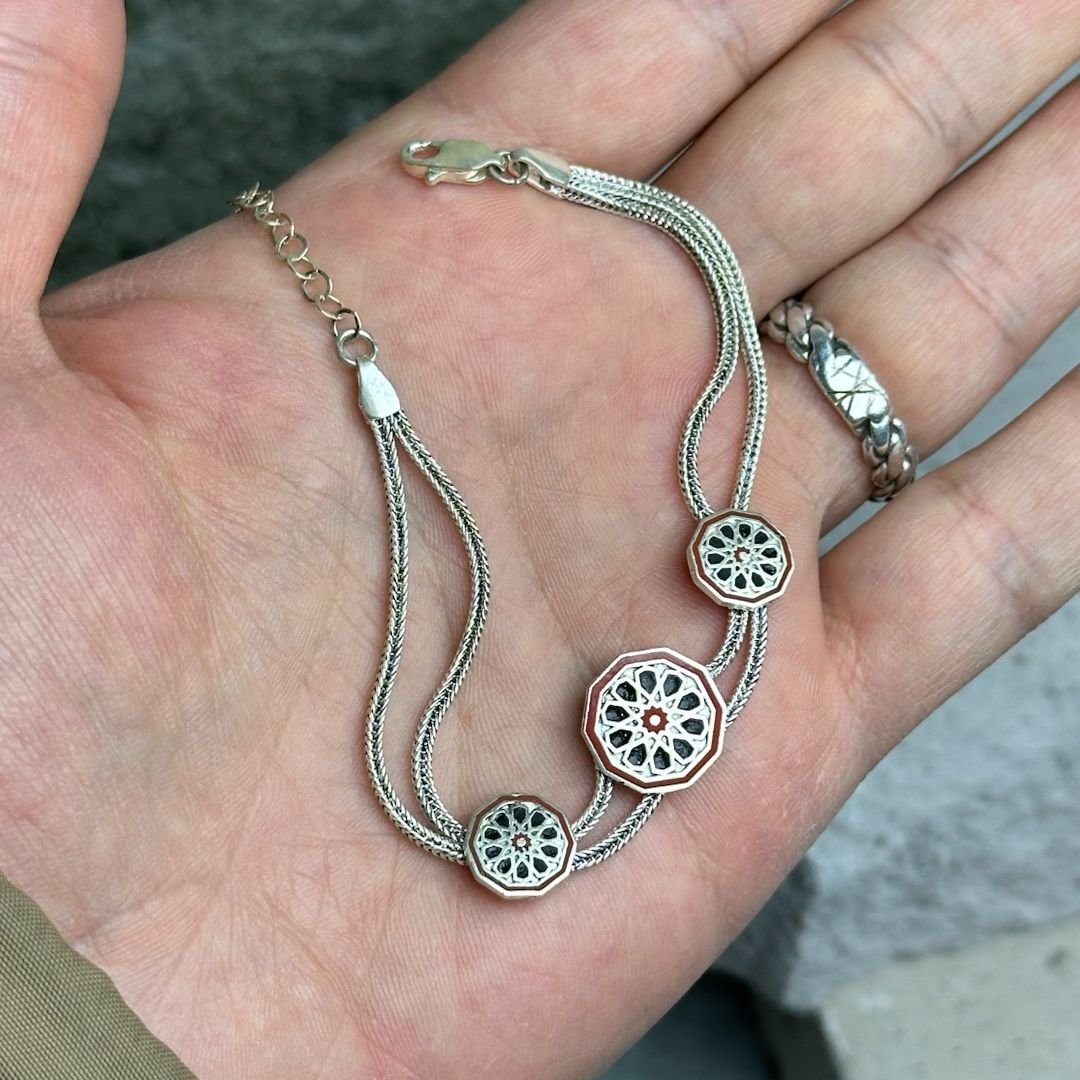
Of the 78 jewellers in the Nadirum catalogue, seven do serious filigree work, and six of those seven are in one small town. Midyat sits in Mardin province, in the southeast of Turkey, closer to Syria and Iraq than to Istanbul. The seventh, Artuklu Telkari, is down the road in Mardin itself. That concentration is not marketing. It is what a craft looks like when it survives in one place and thins out everywhere else.
The Turkish word is telkâri, a hybrid: tel is Turkish for wire, -kâri is the Persian suffix for work or workmanship. Wire-work, literally. Say it tel-KAH-ree. In English it gets called filigree, which is fine but flattens something. Filigree exists in Portugal, in Yemen, in Odisha, in Java. Every one of those traditions does it differently.
What happens at the bench
Start with silver, usually 925 sterling, sometimes finer for the wire itself because purer silver is softer and pulls better.
The first job is the wire, and it is the boring job that decides everything else. The smith pulls a silver rod through a drawplate — a steel block drilled with a row of holes, each one slightly smaller than the last. Pull, anneal, pull again. The rod gets longer and thinner with every pass. By the end the wire is somewhere around a tenth of a millimetre, thin enough that a breath moves it and a careless thumbnail kinks it permanently.
Then two of those wires get twisted together and flattened slightly. That twist is the whole point. It catches light along its length instead of reflecting it in one flat plane, which is why good filigree seems to glow rather than shine.
Next, the frame. Heavier wire is bent into the outline of the piece — a leaf, a teardrop, the border of a pendant — and soldered closed. Now comes the part that looks like magic and is really just patience: the smith fills that frame with tiny coils, spirals, and S-curves of the twisted wire, set on edge, packed in by hand with tweezers, each one touching its neighbours. Nothing holds them yet. A working tray of unsoldered filigree is a held breath.
Solder goes on as powder, dusted over the whole assembly. Then the torch. Too little heat and the joins fail. Too much and the hair-thin filling melts into blobs while the frame is still cold — the entire piece, hours of it, ruined in about two seconds. This is the step that separates a master from an apprentice, and it is the reason a filigree bracelet costs what it costs.
The pieces that come out of it
Look through what the Midyat workshops list and a pattern shows up fast. Sümer Telkari's catalogue runs heavily to florals: leaves and petals built as separate filled frames, then assembled. Telkari Sarayı and Sultan Telkari lean the same way. Artuklu Telkari does more of the big statement work, collars and sets.
Earrings and pendants dominate, and there is a practical reason. Filigree is strong for its weight but not tough — it is an open lattice, so it resists bending in the plane of the wire and gives way to a knock from the side. Things that hang are safer than things that get leaned on. If you want filigree you will actually wear daily, earrings are the smart buy and a wide filigree ring is the sentimental one.
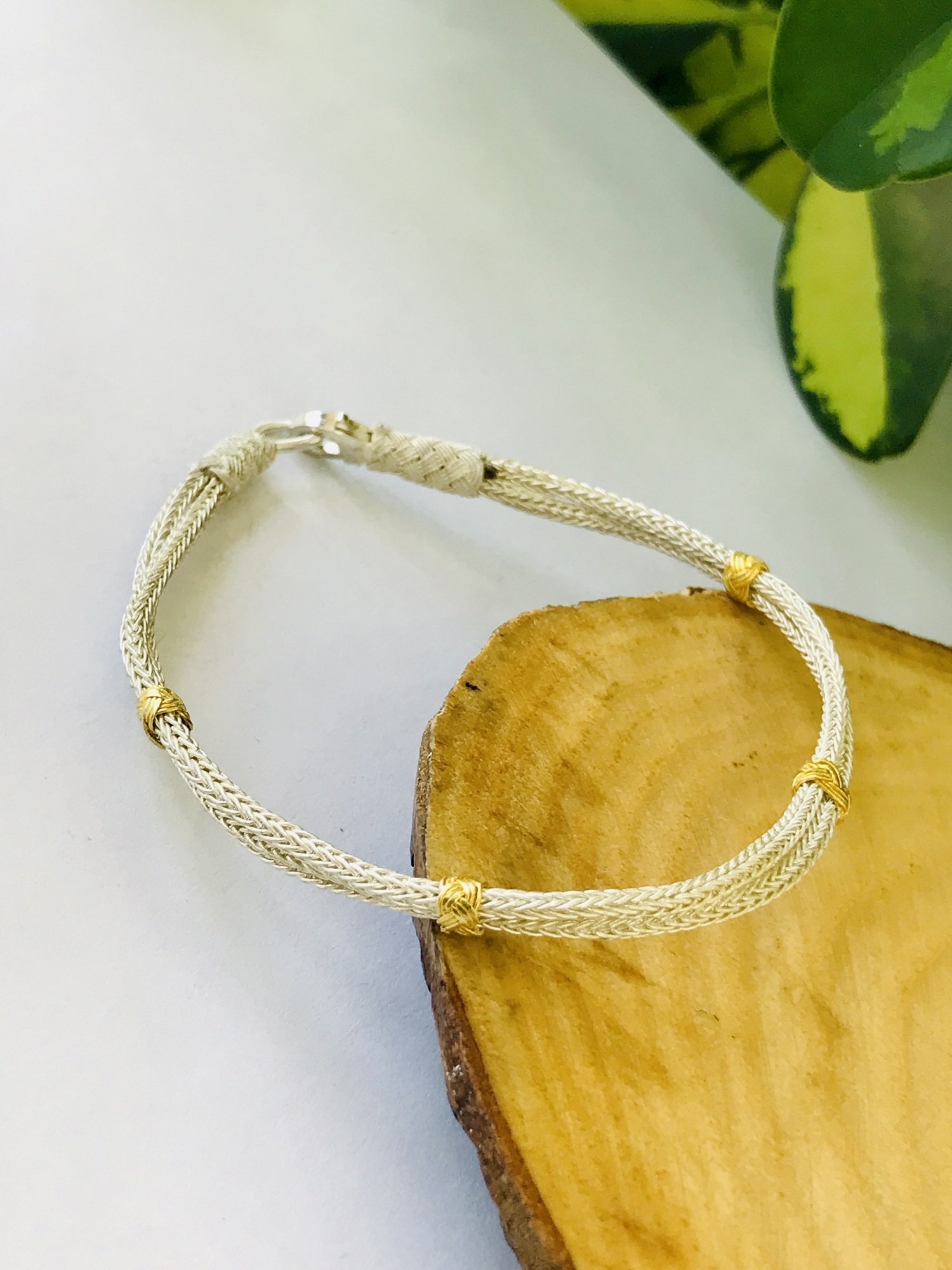
A related technique you will see in the same shops, sometimes mislabelled as filigree in English: kazaziye, fine silver or gold wire woven over a core, associated above all with Trabzon on the Black Sea coast. It is woven, not soldered into open frames. Different craft, different look — denser, rope-like, no negative space. Worth knowing the word so you can tell which one you are looking at — here is how kazaziye is actually woven.
Nobody agrees on where it came from
You will read that telkâri is 5,000 years old, or that it came to Anatolia with the Seljuks, or that Midyat's Syriac Christian silversmiths carried it down through the Ottoman centuries. Wire ornament of some kind turns up in Mesopotamian and Etruscan finds, which is genuinely old and genuinely not the same thing as the Midyat technique.
Here is the honest version: the craft in Midyat has been continuously practised for a long time and was, for much of the last two centuries, associated strongly with local Syriac families. Beyond that, the specific dates in circulation are workshop lore rather than documented history. We would rather leave that gap open than hand you a number that sounds authoritative and is not.
How to spot the fake
This is the part people actually need, because "filigree" has become a style word. A lot of what sells under that name is cast — someone made a mould from a real filigree piece and now pours a hundred copies a day. It is not fraud if it is described honestly. It usually is not described honestly.
Six things to check, in order of how useful they are:
Turn it over. Hand-built filigree is finished on both faces, because it is a lattice with nothing behind it. You should see through it. Cast imitations often have a flat, slightly rough back, or a solid plate where the openwork should continue.
Look for casting mush. Cast metal cannot hold a truly sharp wire edge. Under magnification — your phone camera zoomed in works — a cast "twist" looks softened, like a photo of a twist rather than a twist. Real twisted wire has a crisp spiral you can count.
Find the seams. Casting leaves a parting line where the mould halves met, usually along the side edge, sometimes filed but rarely gone. Soldered filigree has joins instead, small and irregular, at points where wires meet.
Check for repeats that are too perfect. Twelve identical spirals in a row, each one truly identical, means a machine. Hand-coiled spirals are siblings, not clones. This one takes practice but it is the fastest tell once you have it.
Weigh it in your hand, or read the listing weight. Openwork is mostly air. A filigree pendant that feels solid is solid.
Then the hallmark. Turkish silver carries a 925 stamp, often with a maker's mark. A stamp tells you the alloy. It tells you nothing about whether a human made the pattern, which is why it is last on this list and not first.
One more, less reliable but worth a thought: price. Hours of skilled bench time cannot be cheap. If a large, elaborate "handmade filigree" collar costs less than a plain silver chain of the same weight, the maths is telling you something.
If you want to see the difference side by side, the telkâri collection pulls together the Midyat and Mardin workshops in one place. Every piece links out to the jeweller's own site, which is where the live price is. Anything quoted second-hand, ours included, is approximate.
If a friend asked us what to buy, the answer would not be the enormous ceremonial collar — skip that unless you have somewhere to wear it. The underrated buy is a mid-size pair of filigree earrings from one of the Midyat benches. Light, wearable, and you get to own an object that a machine still cannot make.